01
True line of sight
Visibility is ray-cast against the map's real collision geometry. An enemy reads as visible only when there is a clear line to their centre mass, not because the game happened to flag them.

A hardware-driven overlay for Counter-Strike 2. It reads the game from a second machine, works out what you could genuinely see, and draws only that. The aim plans every movement from scratch, and it has good rounds and bad ones.
Most aim assistance travels a curve. A curve is a shape, and a shape on its own is the easy part. What actually separates a person's movement from a machine's is when the speed peaks, how long the whole thing takes, and whether the answer changes from one engagement to the next. Sylnar plans all three, freshly, every single time.
The route is planned again from nothing every time. Most of them bow to one side, leaning early or late; the rest trace a shallow S, which is what a hand does when it corrects part way through. Same start, same target, and no two the same. These are not illustrations, they are the real output.
A machine is fastest on its very first frame and slows from there. An arm builds, peaks, and eases off, and the peak does not sit in the middle. Every movement here is given its own profile, so the moment it is travelling fastest is never twice in the same place.
A person cannot cross a wide angle as quickly as a small one, and how the two relate is not a matter of opinion. Plot what Sylnar plans against how far it has to travel and the points land on that relationship, at r = 0.86. Nothing snaps, nothing is instant, and nothing takes the same time twice.
These are four different questions, and a person answers all of them at once without thinking about it. Most products answer one and treat the rest as decoration. Answering the last one properly is what makes the other three fall into place instead of needing to be faked.
The Humanizer slider moves the whole distribution rather than just widening it. Turn it down and the movement is clean and direct. Turn it up and it is slower, looser and more deliberate, the way a real one is.
Every other layer shapes a single movement. This one carries across the whole match. Sylnar keeps a single number for how well it is going, and that number scales everything else.
The swing on any one shot is deliberately small. The point was never a dramatic difference between two flicks; it is that the four hundredth engagement of a session does not look like the third.
Visibility is ray-cast against the map's real collision geometry. An enemy reads as visible only when there is a clear line to their centre mass, not because the game happened to flag them.
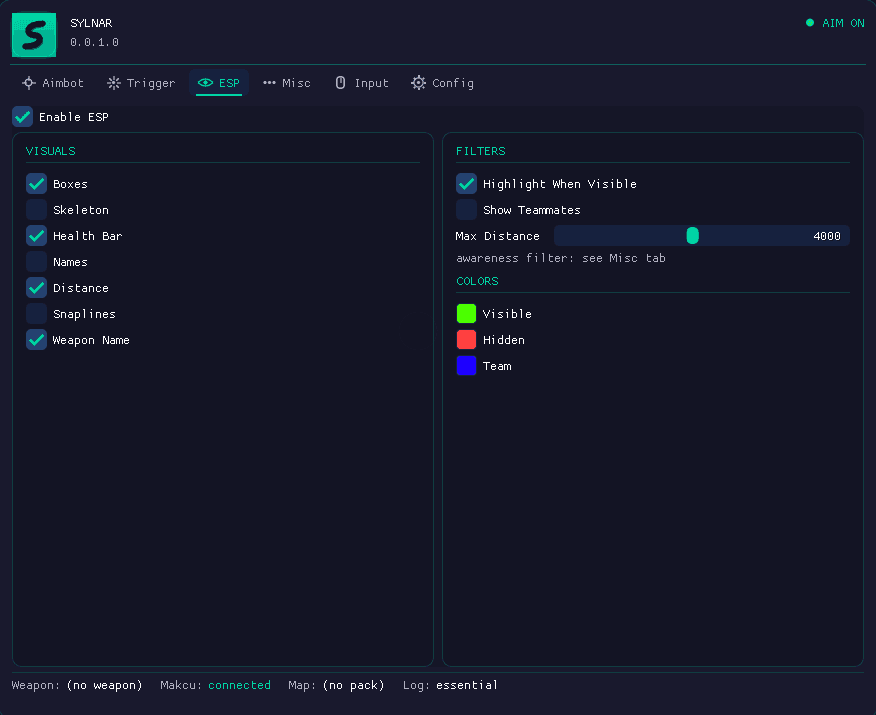
Boxes, skeletons, health bars, names, the weapon they are actually holding and distance. Colour follows real line of sight, so what you see reflects what you could see.
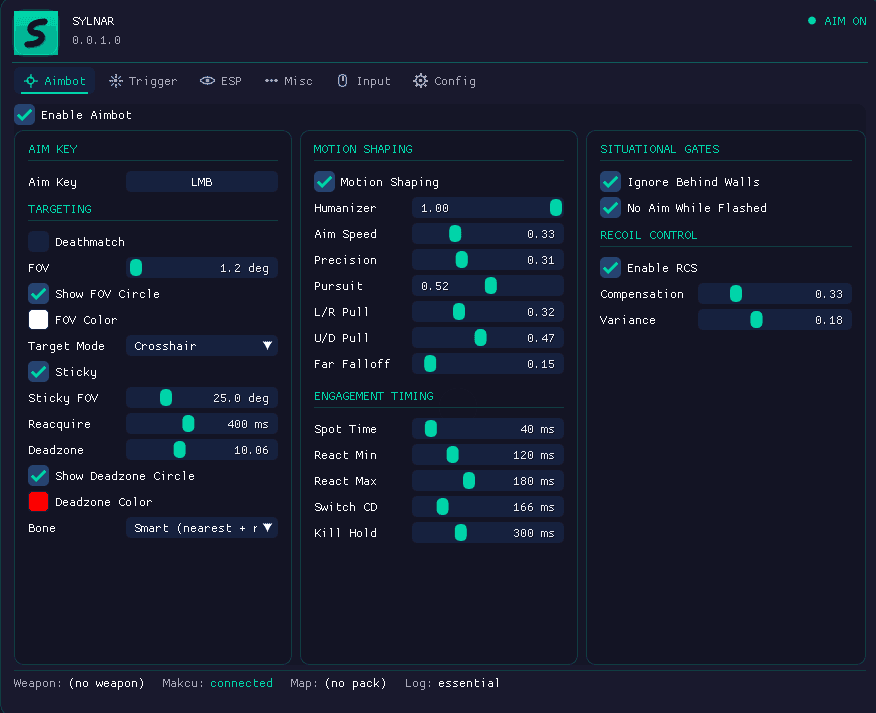
Aim movement is shaped rather than snapped: humaniser, speed, precision, pursuit, separate left/right and up/down pull, and falloff at range.
Spot time, minimum and maximum reaction, target-switch cooldown and kill hold. Every stage of an engagement has its own timing rather than one global delay.
Rules for when not to act at all: ignore targets behind walls, and hold off entirely while flashed.
Compensation with an adjustable variance, driven from live weapon state rather than a recorded spray table, so it follows what the gun is actually doing.
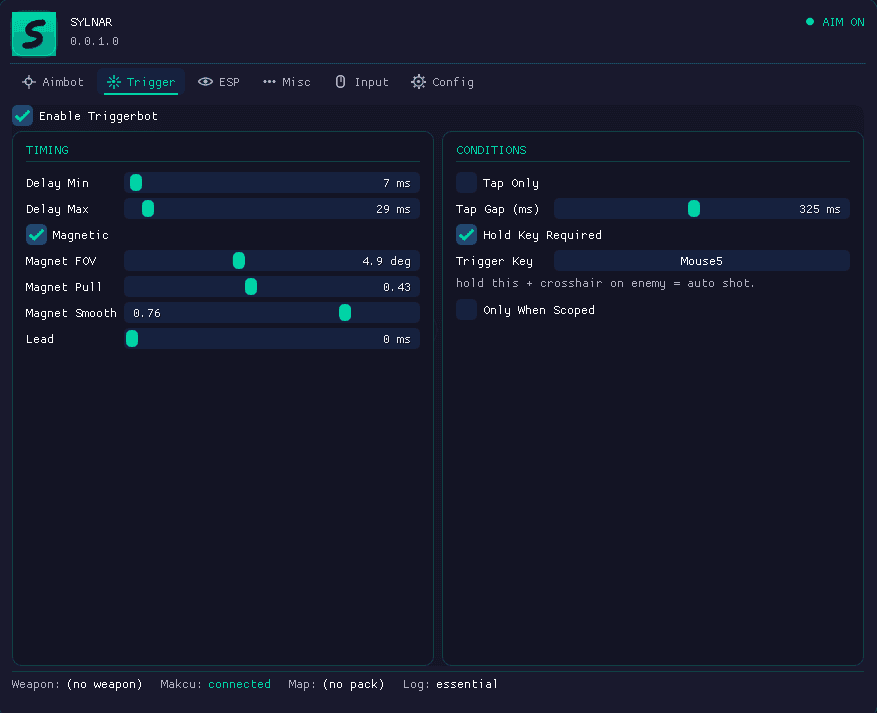
Reaction delay range, magnet field of view, pull strength and smoothing, target lead, tap spacing, and an option to act only while scoped.
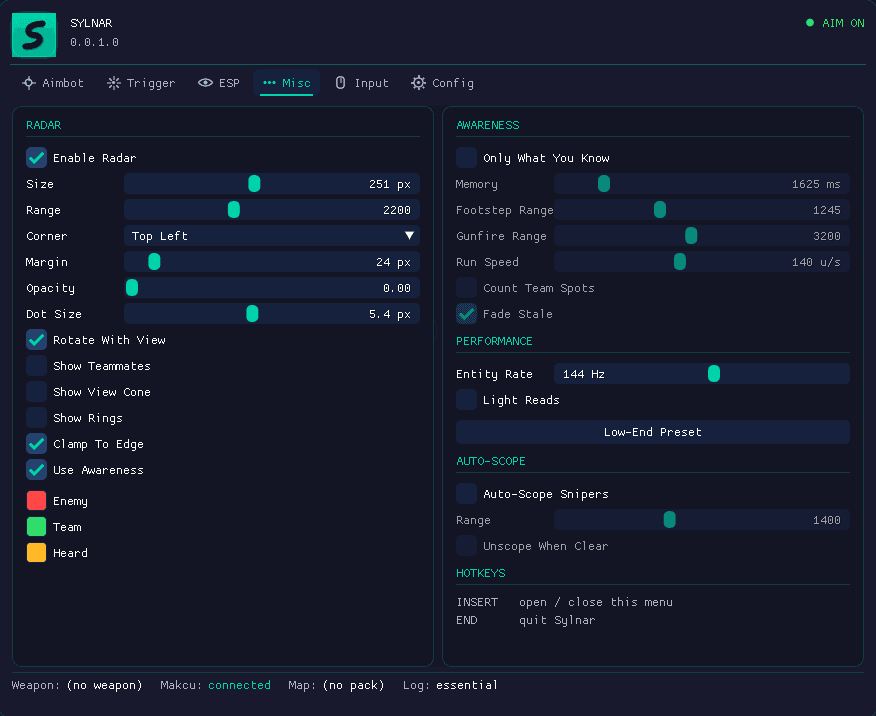
A rotating top-down radar with range rings, a view cone and edge clamping, drawn in the overlay itself. No second screen and nothing to keep in sync.
Optionally limits the display to contacts you could plausibly know about (seen, heard by footstep or gunfire, or called by a teammate) with a memory window that fades them out.
Pre-scopes a sniper when a visible enemy comes into range, and drops back out once the angle is clear again.
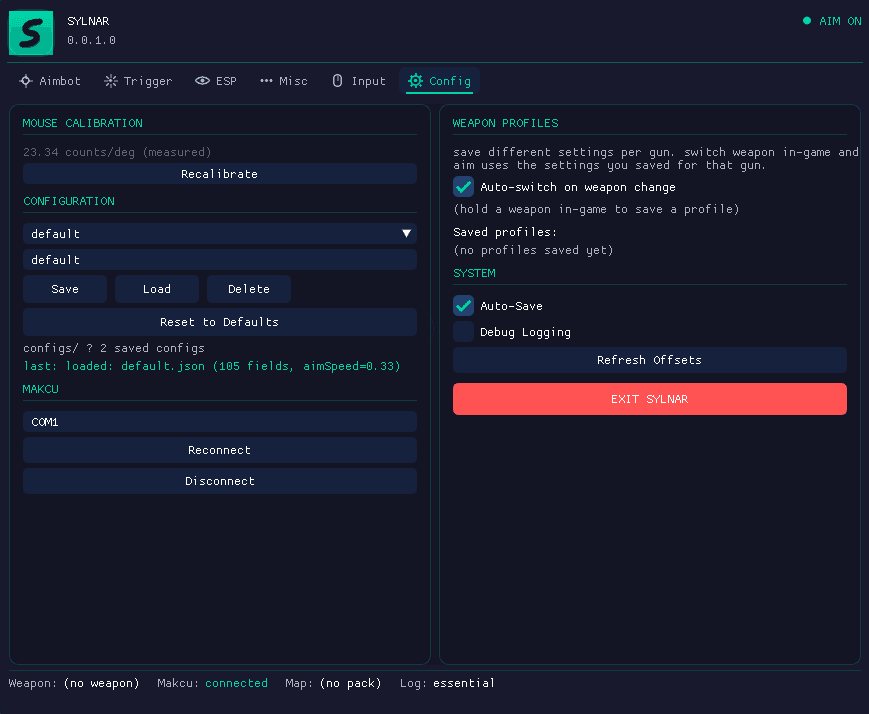
Save a full setup per gun and have it switch automatically as you change weapons in game, so an AWP and an MP9 never share one compromise.
Entity rate, lighter reads and a low-end preset let the same build run well on a modest second PC.
These are the real behaviours, not marketing shapes. The aim model was developed against an offline simulator driven by recoil sampled from live play, which is how the settling behaviour below was verified rather than guessed at.
A snap would put the crosshair on target in a single frame. Instead the movement is shaped: it builds speed, then eases as it arrives, with the curve governed by the speed, precision and pursuit settings.
Outside the field of view the assist does nothing at all. Inside it, the pull engages. Inside the deadzone at the centre it hands control straight back, so the last part of the movement is always yours. Both radii are yours to set.
Error is measured every frame and fed back in, so the aim converges on the target rather than depending on one perfect calculation. A slight overshoot is corrected on the following frames instead of persisting.
Compensation is driven from the weapon's live state rather than a recorded spray table, so it follows what the gun is actually doing on this shot. What remains is the game's own inaccuracy, which nothing can remove, and an adjustable variance so the result is not mechanically perfect.
A body under the crosshair is not enough on its own. It has to be an enemy, alive, and genuinely in line of sight, and then a reaction delay has to elapse. That delay is drawn from a range you set rather than being a fixed number, so no two shots share the same timing. If any check fails, nothing happens at all: the trigger is simply not pulled.
A ray is cast from your eye to the enemy against the map's real collision geometry. Blocked reads hidden, clear reads visible. Where it cannot prove a line, it says hidden rather than guessing.
The gaming PC runs the game and nothing else. Game state is read across to a second machine, which rebuilds the world and draws the overlay on its own display.
Most of what separates Sylnar is not a longer feature list. It is a set of choices about restraint: what it refuses to do, what it insists on proving first, and how much of the movement it leaves to you.
The overlay opens with a single key. Every control carries a plain-language explanation of what it does when you turn it up and when you turn it down.

Runs the game exactly as it always did. Nothing is installed on it and nothing about how you play changes.
A capture card reads memory over PCIe and hands it to the second machine, hundreds of times a second.
Sylnar runs here: it rebuilds the world, ray-casts visibility against the map, and draws the overlay on its own display.
Accounts are open. Create one now and your licence, downloads and per-weapon profiles all live in the same place, including for whatever we build next.